
Ten years of painting island time dwelling in nameless plants through Japanese art. Islander Interviews – Ideal for Your Trip Home
Mari Saito, a Japanese painter Sanuki Hiroshima. While studying Japanese painting in graduate school in Tokyo, she stayed and worked on an island in the Seto Inland Sea, which led her to relocate there. She continues her artistic practice while living on the island.
Saito chooses nameless plants native to the island as motifs for her work. She finds the "flow of time" in their sprouting, stretching, and intertwining forms, rendering them softly and vividly with the delicate touch of Japanese painting.
Walking the island reveals countless captivating motifs—we learned about the influence of this rich island time on her work, her favorite landscapes, and casual daily episodes with islanders.
View her works at the art gallery .
-
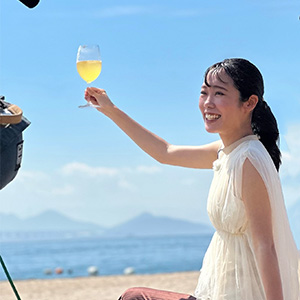
Announcer of island life
Mana

Announcer of island life
Mana
Born in Yokohama. After visiting the Setouchi International Art Festival as a student, she fell in love with the islands and moved to Kagawa, where she joined Setonaikai Broadcasting, covering art, traditional culture, and daily life on the islands.
-
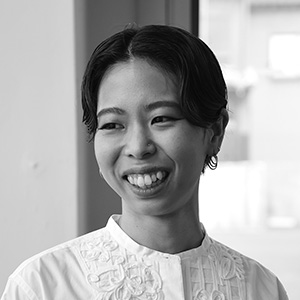
Lives and works in Sanuki Hiroshima
Mari Saito
Lives and works in Sanuki Hiroshima
Mari Saito
A painter originally from Tokyo. While enrolled in a graduate program specializing in Japanese painting, she participated in the "HOT Sandal Project," where art students from across Japan create works during a residency on an island off Marugame City. This experience captivated her, leading her to Sanuki Hiroshima. Her work centers on the theme of "time," using plants native to the island as subjects. Her designs have been featured on national traditional crafts like Marugame uchiwa fans and packaging for the island's specialty products. Interview here
A gentle breeze blows through the plants— Surrounded by motifs I wish to paint, creating art unique to the island.
Saito, originally from Tokyo, first encountered the island through the "HOT Sandal Project" she joined while studying Japanese painting in graduate school. This initiative brought art students from across Japan to Marugame City's remote islands for a residency program, and Ms.Saito spent a summer on Oteshima Island.
"After the project ended, I returned to Tokyo and was working on my graduation piece at university. But I kept thinking how much I enjoyed creating on the island. I just casually mentioned, 'I'd like to live on an island someday.' My professor overheard me. He said, 'Well then, let me introduce you,' and connected me with a graduate who had moved to the island."
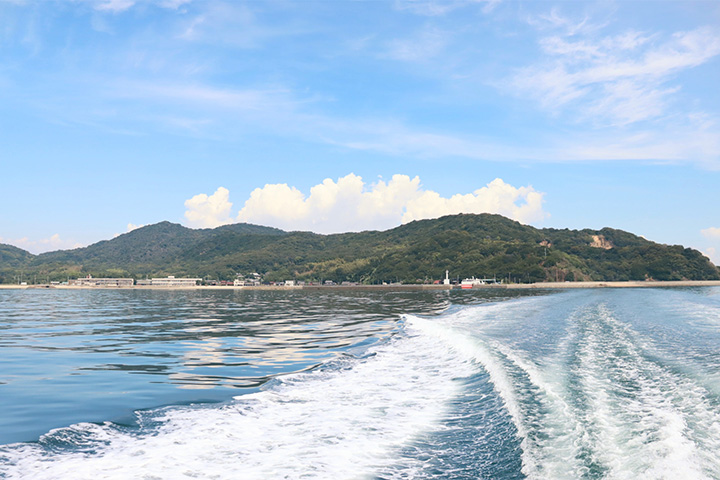
Everything fell into place smoothly, and I was introduced to a home Sanuki Hiroshima. I moved there immediately after graduation. Sanuki Hiroshima had been based in Tokyo and drawing plant motifs, Sanuki Hiroshima was the perfect environment for her work—a place where walking down the street meant encountering countless subjects she wanted to draw.
In the city, people inevitably manage and maintain things, so nameless plants get cut down. But on the island, I find immense charm in places where all sorts of plants are tangled together. When I want to paint a single scene, I first take a walk around the neighborhood, wandering for two or three days until I find the spot I want to capture. Sanuki Hiroshima, I've gradually come to know where certain plants bloom in each season. Lately, I often find myself thinking, 'That spot should be looking like this by now!' and going out to look for it. I'm often crouched down, looking down, searching, so when islanders pass by, they give me a suspicious look for a moment, then realize, 'Oh, it's just Mari-chan!'"
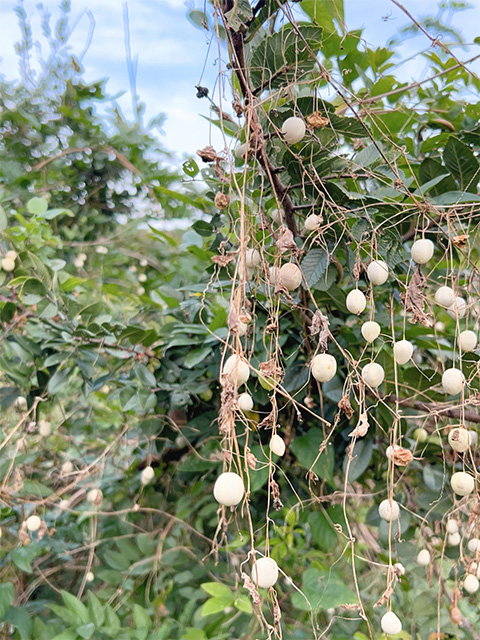
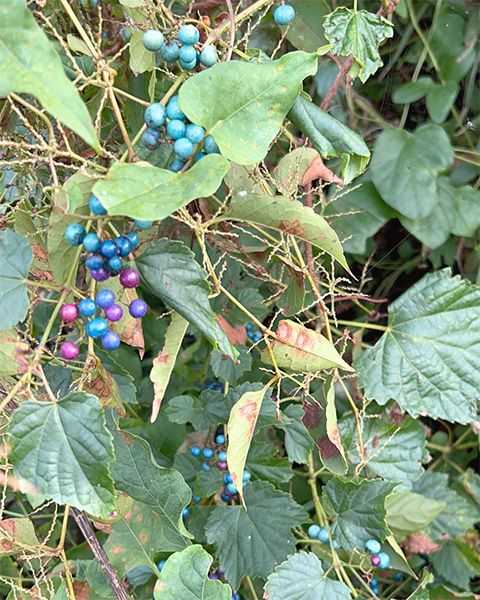
I love the jungle-like scene where various sculpted plants intertwine.
She uses the plants of Sanuki Hiroshima to depict the very existence of "time."
"Plants make time visible as it passes. Trees grow taller, branches extend and lengthen... That's how I see them. For instance, when a baby is born, you plant a tree in the garden. Then, as the child grows, you watch the tree grow too. Even people who don't paint can feel the seasons and the passage of time through plants, right?"
"Drawing time through plants" itself has remained an important theme since my time in Tokyo. However, living Sanuki Hiroshima has brought changes to my use of color and creative process.
When I graduated from graduate school, I was really just drawing monochrome pictures with ink on washi paper. But whether it was the different light in Tokyo or being overwhelmed by the vitality of plants, I think colors gradually started appearing and my work became more vivid.When it comes to drawing plants, living in Tokyo meant spending a huge amount of time just taking the train to find subjects. So maintaining the desire to draw was tough. But on an island, within a two-minute walk, there are more subjects than I could possibly draw—so many it's almost a problem. When I think, 'I want to draw this!' I can just go home, grab my sketchbook, and come right back to draw. That ability to do that really helps keep my motivation to keep drawing alive."
Shimarebi, we asked Ms. Saito to paint her favorite view. The location he chose is Enoura Beach, just a five-minute walk from the port. Through the gaps in the leaves of her favorite plant, the palm tree, the gentle Seto Inland Sea and the Sanuki Hiroshima rock, Sanuki Hiroshima, carry the summer breeze.
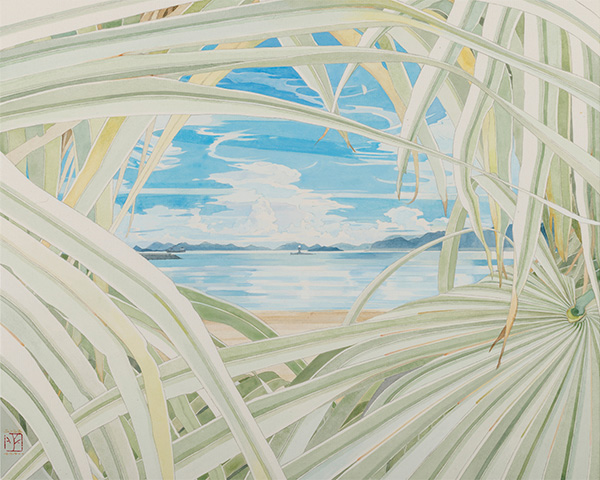
"Guide on the Water's Surface"
I love compositions where you see something through a gap. The palm tree in the foreground is also one of my favorite plants. This spot is nearby, so when I hit a wall, I come here just to look at the view. Every day, every hour, the cloud shapes are completely different, interesting ships are moored, or you can watch the tides come in and out. I absolutely love that there's never the same view twice—it's about encountering those unique moments.This time I'm painting a summer scene, but winter has its own charm—the air is so clear and beautiful, so I highly recommend visiting in winter too."
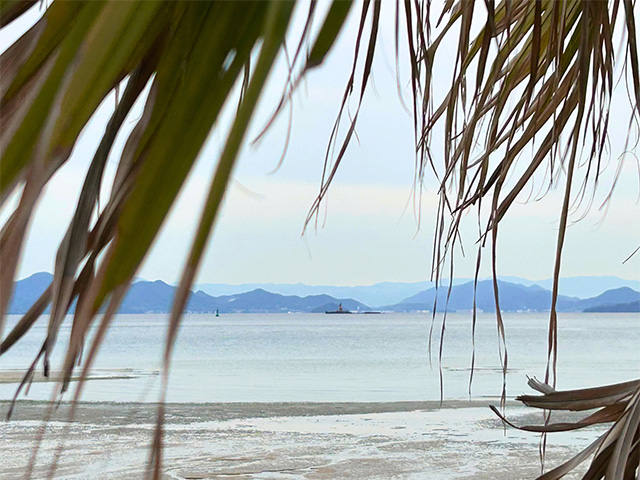
Winter scene at Enoura Beach. Palm trees line the gently sloping shoreline, swaying in the wind.
Over the past decade, I've encountered countless favorite views. Sanuki Hiroshima, boasting mountains offering breathtaking vistas like "Shingyo-zan," where Kobo Daishi Kukai is said to have trained, and "Oto-zan," the highest peak in the Shiwaku Islands.
"Of course, Enoura Beach is wonderful, but the view of the Seto Inland Sea from the mountains is truly beautiful too. As you gradually climb higher, the plants and scenery change. Watching that, seeing the distant horizon gradually rise—I really love being able to see that."
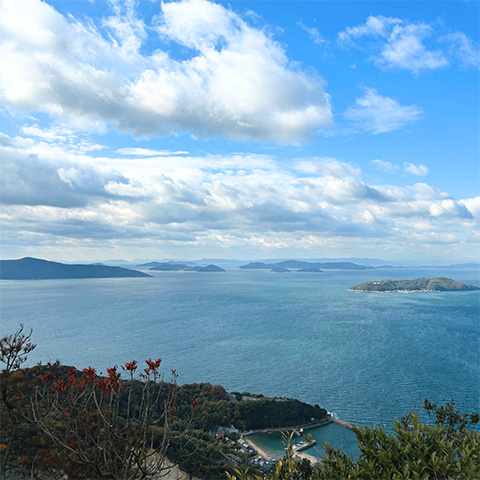
Sanuki Hiroshima brought changes not only to my work but also to my daily life.
"I started living by going to sleep when it got dark and waking up when it got light. I often get to eat seasonal produce like the vegetables everyone grows, akebi, and fish—it feels like such a luxurious life. People bring over fish they've caught, saying 'Look what I caught!' or I come home to find vegetables left at my doorstep...
There are these friendly old guys, and one day they suddenly showed up at my door: "Mari-chan! Let's go pick yamamomo berries!" "Sure, why not!" I said, put on my rubber boots, grabbed my straw hat, and headed into the mountains.I'd stand under the tree with an upside-down umbrella, and when the guys shook the tree, the yamamomo berries would come tumbling down into the umbrella, bam bam bam bam. We'd all share and eat them together... I'm really helped by my close-knit group of uncles and everyone else. I'm so grateful that everyone gets involved."
The island's time, as only Ms. Saito, who lives Sanuki Hiroshima, can depict. Today, her creative activities have expanded beyond painting to include designing traditional national crafts like Marugame uchiwa fans, packaging for souvenirs, and creating maps for Sanuki Hiroshima "Onoe Residence."
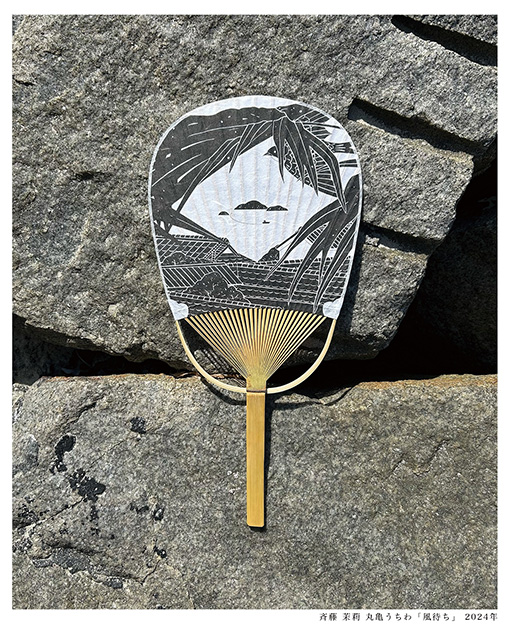
Connecting with various people and receiving work across different genres—being able to try things I've never done before is truly a blessing. While I usually draw plants, painting landscapes Shimarebi time made me realize that landscapes can also express "time" in a way. I want to challenge myself in various ways—not just sticking to what I feel I must do, but exploring my own methods of expression.
Amidst the island's rich nature, countless plants sprout, heralding the seasons. Ms. Saito's works, delicately capturing their hues and forms, reflect the flow of time on the island.
View Ms. Saito's Shimarebi on the " Art Gallery " page Shimarebi.
-

Ten years of painting island time dwelling in nameless plants through Japanese art.
-

Island Time Near the Seto Ohashi Bridge—Connecting History and Nature to the Future.
-

Yamaguchi Store, which once supported island life, and Ogijima old tales.
-
Awashima art activities supported by the island's grandmothers
-

World-renowned faceted glass artist finds the starting point of his creation in Shodoshima
-

The island time of Teshima resident artists that enriches both their works and their lives.
-

Why the "Sunset Guy" has been shooting only Naoshima sunsets for 10 years
-

Behind the Scenes at Naoshima Art Sanctuary - Interviews with a Famous Guide
-

What is the best season to visit Naoshima & tips to enjoy Setogei many times over?
-

Global Grandpa welcomes you in his old house.
-

Love at first sight on the island! How to enjoy Megijima after moving to the island.
-

Artists talk about Teshima as more than just art.
-

The way to enjoy Naoshima beyond art, discovered through living and playing.