
ShodoshimaA metal casting artist visits Awashima. What is this foundry that captures the island’s atmosphere? Islander Interviews – Ideal for Your Trip Home
AwashimaAwashimaAt “ Awashima,” an art facility housed in a former junior high school, an artist-in-residence program has been held annually since 2010. Metal casting artist Saho Shibata, who stayed for about three months starting in July 2026, turned the foundry itself into a work of art.From melting aluminum cans brought in by island residents in a furnace she built herself to using the shells of squid washed ashore as molds—the works born from her interactions with the islanders reflected memories of her life at “ .” We asked her to look back on the three months she spent at “ Awashima,” sharing what her days were like and the charms and discoveries she encountered.
-
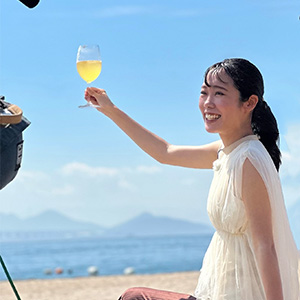
Announcer of island life
Mana

Announcer of island life
Mana
Born in Yokohama. After visiting the Setouchi International Art Festival as a student, she fell in love with the islands and moved to Kagawa, where she joined Setonaikai Broadcasting, covering art, traditional culture, and daily life on the islands.
-
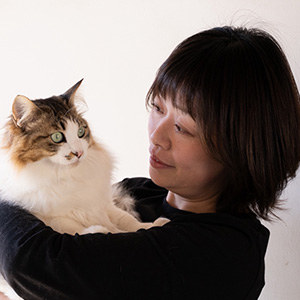
ShodoshimaResident
Saho Shibata
ShodoshimaResident
Saho Shibata
Born in Osaka Prefecture; has lived in Shodoshimasince the age of five. Metal casting artist. Studied metal casting at the University of Toyama and the Tokyo University of the Arts. Completed the Doctoral Program in Crafts (Metal Casting) at the Tokyo University of the Arts in 2018. Currently operates the “Miyanomori Casting Studio” at Shodoshima, where she collects local personal histories starting with the gathering of materials and creates works based on these stories.As a member of the “Shodoshima Folklore Roundtable,” she also writes and edits collections of oral histories. In recent years, she has been engaged in research and artistic creation focused on the Seto Inland Sea and local life through collaborations with scientists. Click here for the interview
The Story Behind the Creation of “ Awashima,” a Foundry That Warms the Passage of Time
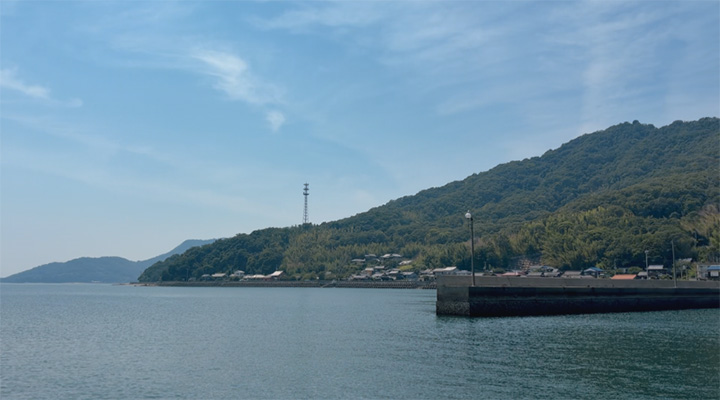
Awashima, located about a 15-minute boat ride from the port in Mitoyo City, Kagawa Prefecture. The art facility “ Awashima” has been hosting artist-in-residence programs since 2010, inviting artists from Japan and abroad nearly every year. In 2026, two artists with ties to Kagawa Prefecture—Saho Shibata and Daichi Taniguchi—were invited to create works during a residency lasting approximately three months starting in July.
What did metal casting artist Shibata feel at this new location, Awashima, and what kind of works did she create? We asked her to reflect on the three months she spent at Awashima.
Mr. Shibata, who grew up in Shodoshimafrom the age of five, studied metal casting at the University of Toyama and the Graduate School of Tokyo University of the Arts. He currently runs a studio called “Miyanomori Casting Studio” at Shodoshima. His artistic style is deeply rooted in the local materials and history of the region. For example, he has incorporated the unique character of the land into his works by using sandstone collected from the geological strata at Shodoshimaas molds for pouring metal.
“When I trace the materials and the land through my own casting work, I begin to see memories of people’s lives and industries—memories that Shodoshimahardly anyone knows about anymore. I’m also involved in an initiative where my colleagues and I interview people about these personal histories and document them in a zine.”
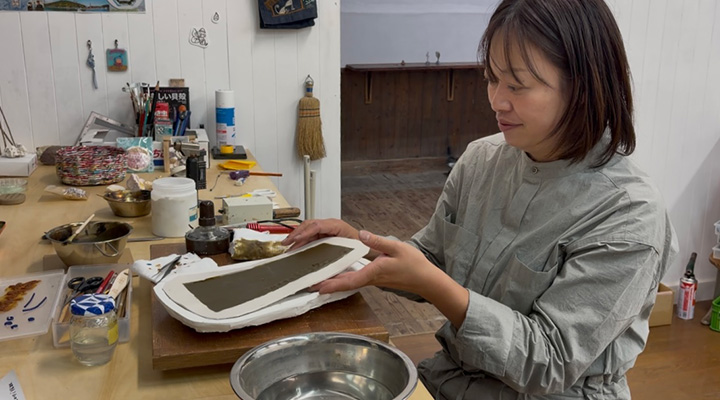
Exploring the materials of a place also helps to unearth memories of its past industries and the lives of its people. Moving back and forth between this research and his creative process, Mr. Shibata has used the art of casting to weave stories unique to each location.
Mr. Shibata, who has ties to Kagawa, first arrived at Awashimain July, when the summer sun was blazing. His first goal on the island was to build a foundry unique to Awashima. He began by building his own melting furnace.
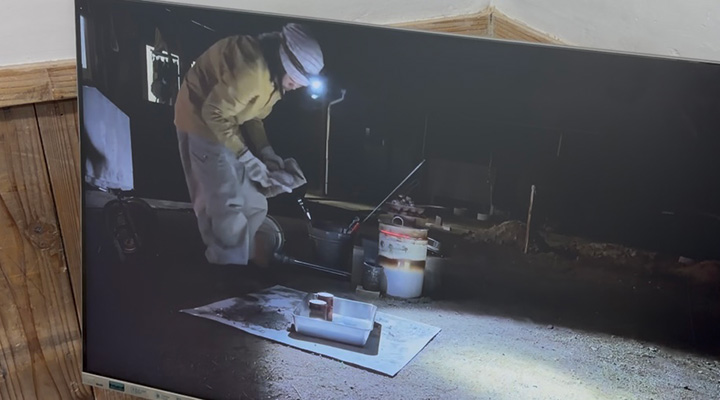
Mr. Shibata, who creates his own pieces from the melting furnace
“When we were bringing a lot of supplies to the island, everyone at the harbor helped us drag the cargo all the way to the boat. I’m truly grateful—and it was so much fun—to see that even heavy cargo can become a tool for building connections.”
As the foundry took shape, a preview event for island residents was held the day before the exhibition opened. Mr. Shibata performed a live demonstration in which he melted empty cans—left behind by islanders—in his homemade melting furnace and poured the molten metal into seashells collected by the islanders to create artworks. At the end, everyone joined in a traditional clapping ritual to celebrate, sharing a joyful moment together.
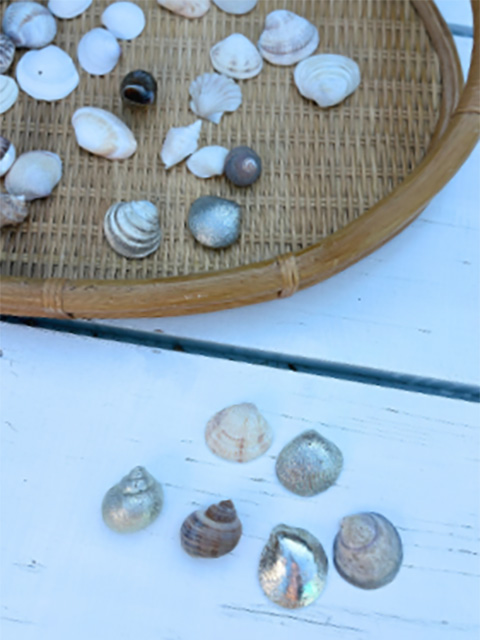
Seashells can also be used as "molds" for metal casting.
The title of this exhibition is “ Awashima.” Below that, Mr. Shibata added the following subtitle:
“Hello, someone whose face and name I don’t know. To you, whom I’ve just met—nice to meet you. —And to someone whose face and name I don’t know.”
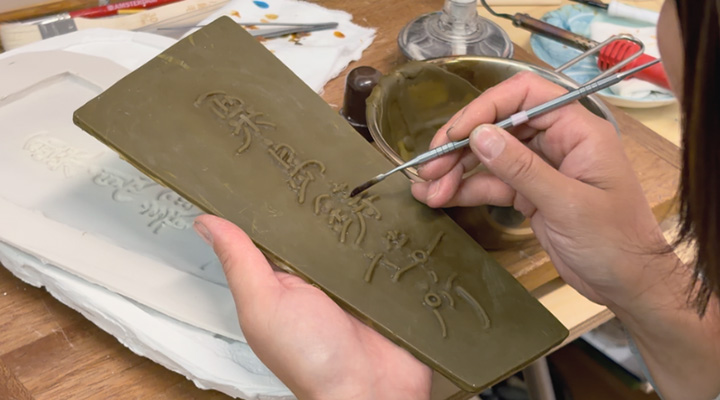
“You notice a lot of vacant houses on the island, don’t you? Of course, I’m sure there are various issues involved, but as I rode my bike around every day, I found myself thinking that the way inhabited and uninhabited homes are gently connected—that in itself is something I can really appreciate. When I see the scenery with vacant houses and old graves still standing, my thoughts wander to the beliefs and forms of prayer of people from the past, and I wonder what they were thinking.The ‘Hello’ part expresses that feeling—as if I’m greeting someone from some bygone era, someone whose face and name I don’t know, who once lived somewhere.”
There are people who lived in the past. And by saying “Nice to meet you” to the islanders I encounter now, the cats that visit my studio, and the insects and plants, I’m connecting to someone in the future whom I haven’t yet met—that’s the flow of time embedded in this work.
“We’ve carried on from the past while living and creating new things in the present, and we tied that feeling—that someday we’ll surely connect with someone—together with the final words, ‘And to someone whose face and name we do not know.’ Rather than trying to define and understand such things through concepts like views on life and death or other labels, I thought it would be nice to express the very atmosphere flowing through the island right now through art.”
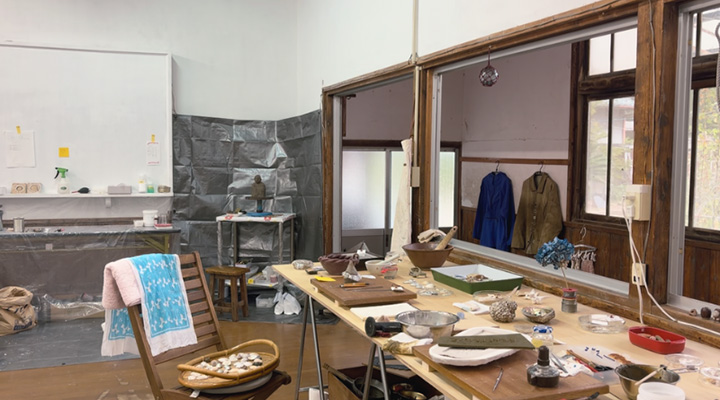
Born from this vision, the “ Awashima” has become a space where visitors can explore the fascination of the casting process—from creating prototypes and molds to melting metal and pouring it into the mold.Amidst the various tools, “sand from the Sahara Desert” shared by a former sailor in his 90s, seashells collected by islanders over many years, and plants I finally found after fulfilling a long-held wish by talking to the locals are all lined up in a row. The encounters and moments born “right now” while living at Awashimawere on full display.
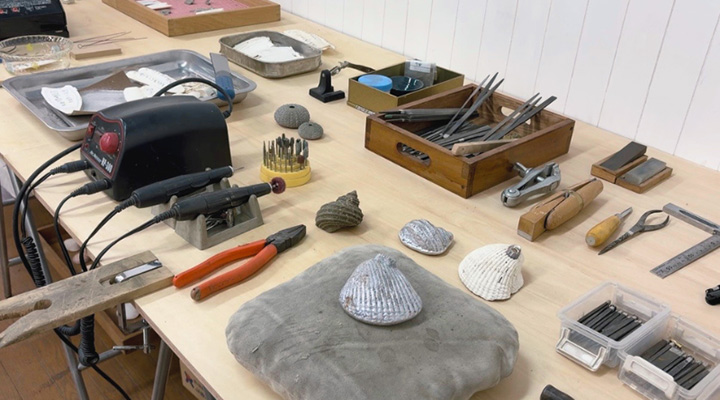
“Don’t the people who live on the island know its history better than I do? Since it’s all new to me, I could enjoy putting on an exhibition just based on that alone, but I feel that without my own questions, I can’t really bring out the true fascination of it all. So, at Awashima, I looked at and listened to all sorts of things, and I constantly found myself forming my own questions about them. Then, at Awashima, I actually realized that when I do that, I’m able to listen to and experience the next thing that comes my way with even greater breadth and depth.“The role of a museum that simply displays old objects as they are is important, and these pieces inherently possess their own artistic appeal. But I built this foundry while asking myself, ‘So, what can I do with them?’”
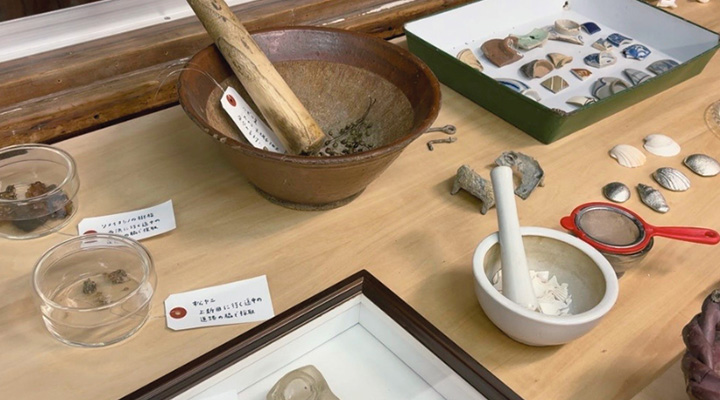
Shortly after beginning his stay at Awashima, Mr. Shibata cycled around the island and ventured to the edge of the village. It happened to be low tide, and when he stepped down onto the sandy beach—which is normally inaccessible—he found a fragment of weathered pottery. When he asked an acquaintance in Aji (Takamatsu City) about it, the person suggested it might be an “ii-dako pot” used for catching ii-dako.The Iidako pot I had was missing half of its body, but Mr. Shibata saw potential in that “missing” part.
“I thought I’d create a cast sculpture for the missing part and use it to imagine the era when that piece was there, or the scene of catching Iidako. I think we tend to talk only about what we can see, but wouldn’t it be fun if we all tried to imagine what’s ‘not there’ as well?”
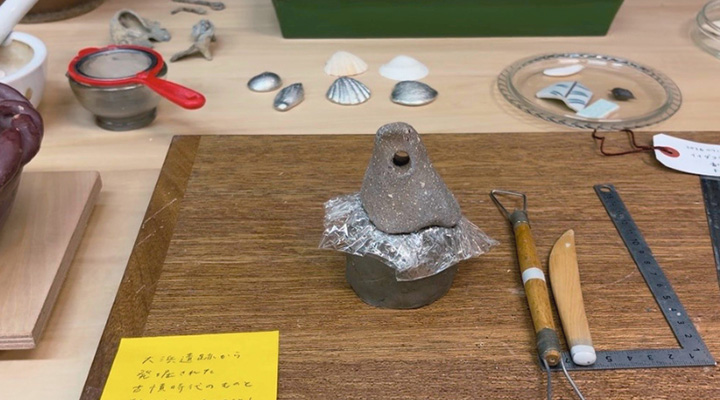
When I reported my find to the local folk museum, I learned that because its shape resembled that of an “Iidako” jar unearthed from a nearby archaeological site, it was believed to date back to the Kofun period. It was a piece of pottery I stumbled upon by chance, lying there on the sandy beach. The very act of reflecting on the parts of it that were missing became part of the artwork itself.
“Usually, when I collect personal histories at Shodoshima, it feels as though I’m receiving ancient memories. These memories continuously answer the questions I hold within myself about daily life and the local community. So, while talking with my colleagues at Shodoshima, we discussed how we—who are living today—shouldn’t just trace history; rather, by receiving these ancient memories, we can imagine new possibilities and pass them on to the next generation, thereby creating something new in that space of imagination.This Iidako Jar embodies exactly the same idea. Sometimes it matters whether something is “true,” and other times, “imagination” is more important than whether it’s true. I hope we can all choose what’s most important in each moment and have fun doing it.”
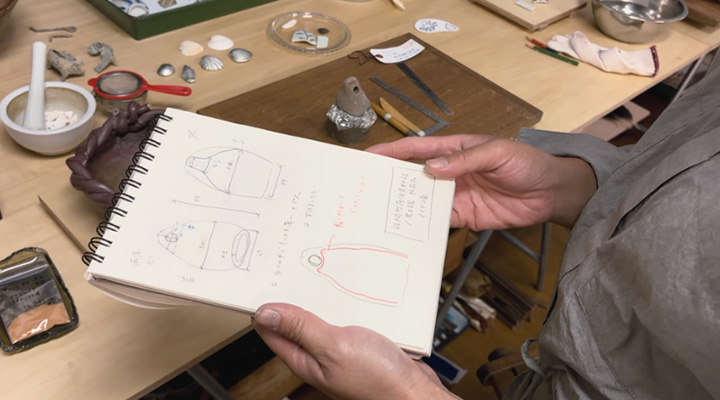
What we can see is not everything. Even when there are no answers, it’s important to find joy in the process. Shibata explains that, for him, his creative work is also an exploration of this “humanity.” It is precisely in the aspects that sometimes seem pointless that richness and humanity reside. This consistent philosophy was evident in the way he engaged with the Iidako jar—an artifact that had traveled through time from the Kofun period to reach him.
AwashimaThose three months also gave Shibata a new perspective. Shodoshima, where she normally lives, is the second-largest island in the Seto Inland Sea—a vast island that takes about four hours to drive around. It has a population of about 20,000. In contrast, Awashimais a relatively small island that you can traverse from one end to the other by bicycle, with a population of about 100. Looking back, she reflects that the sense of scale on Awashimaand the warm, approachable nature of the islanders were crucial sensibilities for her creative process.Above all, he says the islanders’ genuine reactions helped him reexamine the origins of his creative work.
“Coming to Awashimareally made me realize just how much I love casting. Just hearing everyone say things like, ‘I’ve never seen anything like this’ or ‘Casting is fun’—those words alone made me incredibly happy.”
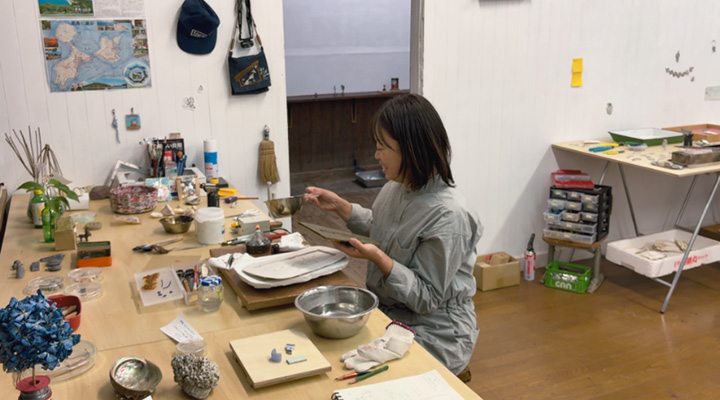
Casting involves many processes that are both physically demanding and take place in intense heat. It’s said that even a slight change in the specifications of the prototype can lead to failure, sometimes causing several days’ worth of work to go down the drain. However, upon encountering the islanders’ innocent questions—such as “How do you melt aluminum cans?”—and seeing their joyful expressions during workshops where they worked together to make molds from squid shells and pour metal into them, he reportedly rediscovered the fascination and joy of casting.
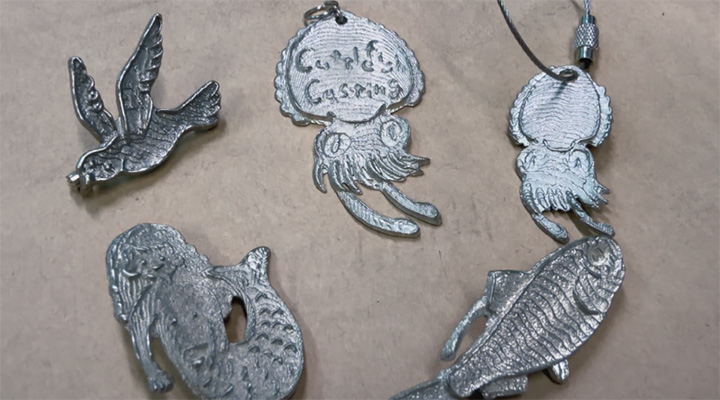
"Whether I succeed or fail, I’m glad I was able to help everyone realize that casting is truly fun and something I love. I hope to continue building this relationship so that the islanders will continue to feel that ‘it was great to have you visit’ in the future."
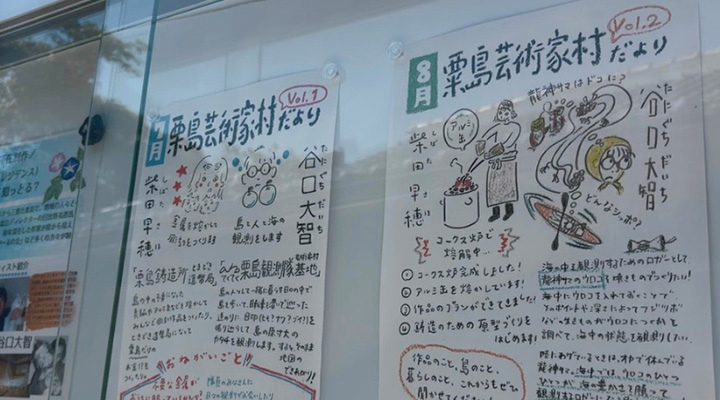
The art exhibition was a great success. You can view footage of Saho Shibata and Daichi Taniguchi’s creative process and the exhibition in the “ News Video ” section, and watch an interview about the artist-in-residence program in “ShimarebiIslander Interviews – Ideal for Your Trip Home ” section.
At the “ AwashimaArtists’ Village,” which is open every Saturday afternoon, you can view past works in the permanent and archive exhibitions. You may even see volunteers and island residents wearing brooches and keychains they made together with Ms. Shibata. Please feel free to say hello.
-

A Three-Month Artist-in-Residence: From Clay to Finished Pottery at the " Awashima"
-
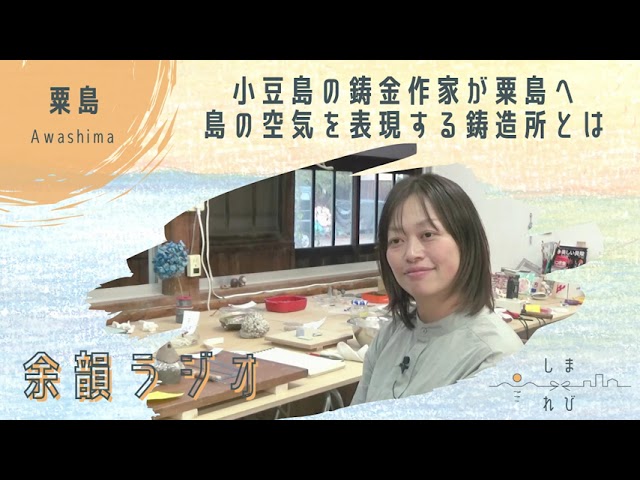
ShodoshimaA metal casting artist visits Awashima. What is this foundry that captures the island’s atmosphere?
-

Ten years of painting island time dwelling in nameless plants through Japanese art.
-

Island Time Near the Seto Ohashi Bridge—Connecting History and Nature to the Future.
-

Yamaguchi Store, which once supported island life, and Ogijima old tales.
-
Awashima art activities supported by the island's grandmothers
-

World-renowned faceted glass artist finds the starting point of his creation in Shodoshima
-

The island time of Teshima resident artists that enriches both their works and their lives.
-

Why the "Sunset Guy" has been shooting only Naoshima sunsets for 10 years
-

Behind the Scenes at Naoshima Art Sanctuary - Interviews with a Famous Guide
-

What is the best season to visit Naoshima & tips to enjoy Setogei many times over?
-

Global Grandpa welcomes you in his old house.
-

Love at first sight on the island! How to enjoy Megijima after moving to the island.
-

Artists talk about Teshima as more than just art.
-

The way to enjoy Naoshima beyond art, discovered through living and playing.